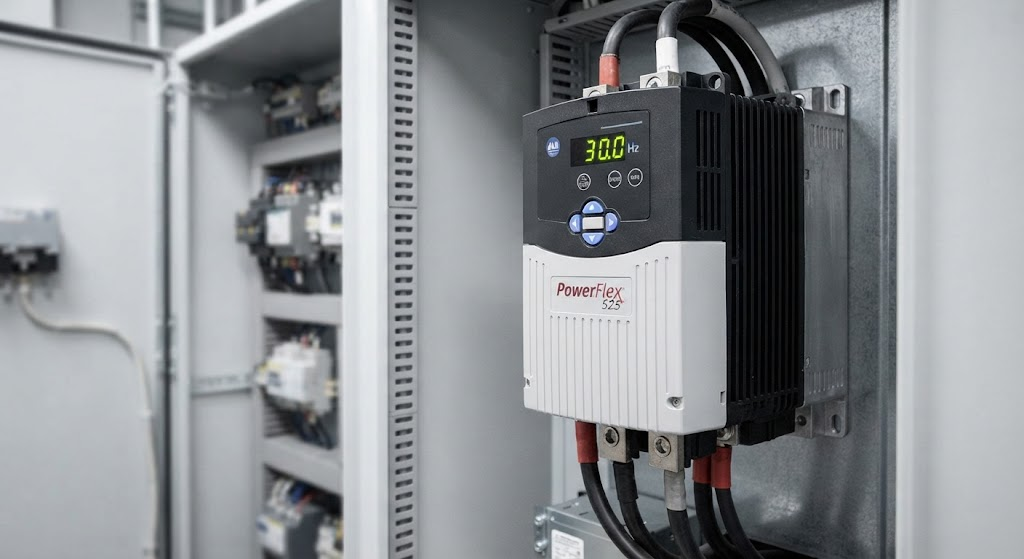
A variable frequency drive, or VFD, controls the speed and torque behavior of an AC motor by controlling the electrical waveform delivered to it. Conveyors, pumps, fans, mixers, and machine axes use drives when the process needs controlled acceleration, adjustable speed, or energy management instead of a simple across-the-line starter.
The drive is one part of a larger control system. The motor, mechanical load, wiring, protection, PLC, HMI, and process sequence all affect whether the application works reliably.
How a VFD changes motor speed
For an AC motor, operating frequency is closely related to synchronous speed. A drive changes frequency and voltage together according to its control method and motor data. It can ramp a motor instead of applying full starting current immediately, then regulate the commanded speed while monitoring current, voltage, temperature, and other conditions.
Actual motor behavior also depends on load torque, motor nameplate information, tuning, acceleration and deceleration settings, and the drive’s control mode. A speed command alone does not guarantee that the motor can accelerate a loaded conveyor or stop within a particular distance.
What the PLC typically sends
- Run forward, run reverse, enable, or start permission
- A speed reference through an industrial network, analog signal, or preset speed
- Reset commands after the fault condition has been addressed
- Mode, direction, or process-specific commands where the application requires them
Networked control reduces point-to-point wiring but introduces addressing, data mapping, and communication diagnostics. Analog control is simple in some applications but requires correct scaling, shielding, grounding, and signal interpretation.
What the drive reports back
A useful interface reports running status, commanded speed, actual speed or frequency, output current, ready or enabled state, and fault information. The PLC should use those signals to build clear permissives and alarms rather than assuming that a run command means the motor is running.
A fault code belongs first to the drive and its power or motor circuit. For example, a PowerFlex 525 fault should be investigated using the relevant drive documentation, parameters, and operating conditions rather than immediately changing PLC logic. See PowerFlex 525 troubleshooting and the PowerFlex 525 fault-code reference.
Important commissioning checks
- Confirm motor nameplate data and the drive application settings.
- Verify rotation with the machine in a safe condition and the load controlled.
- Test acceleration, deceleration, stop behavior, and restart behavior.
- Confirm the selected control source and speed reference.
- Test loss of communication, drive fault, overload, and permissive conditions.
Electrical work around drives and motors should be performed by qualified personnel using the site’s isolation and verification procedures. If a drive repeatedly faults or the PLC, network, and motor behavior do not agree, TechControl provides VFD programming and industrial troubleshooting for existing equipment.
Ready to bring your project to life?
Contact Us