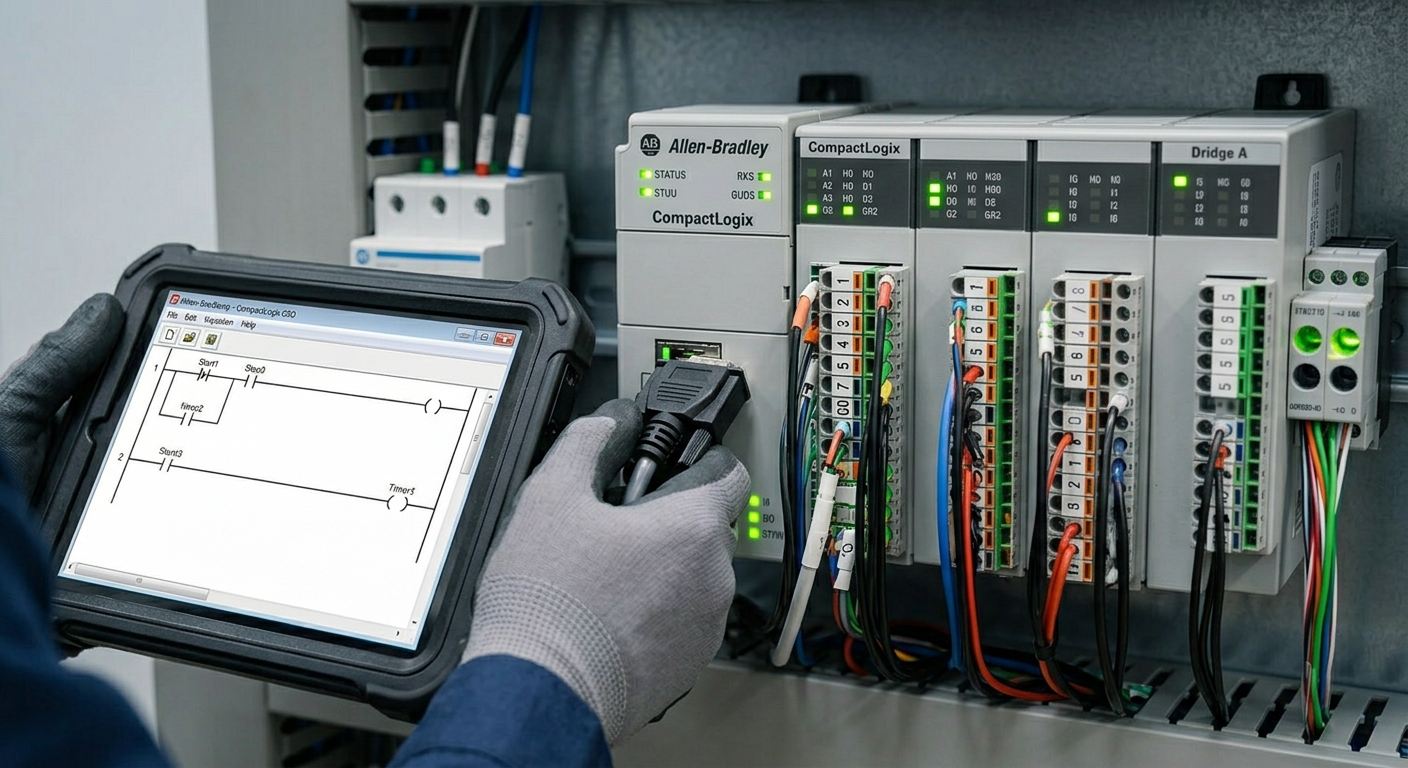
PLC programming is the work of turning a machine sequence into logic that is predictable, diagnosable, and maintainable. The task is more than making an output turn on. A good program explains why a machine is waiting, protects transitions between steps, handles faults deliberately, and gives the next person enough structure to make a safe change.
Understand the scan cycle
A controller repeatedly reads input data, executes tasks and routines, updates outputs, and handles communications and housekeeping. The exact execution model varies by platform and task configuration, but scan behavior affects timers, one-shot logic, handshakes, and the way a program sees changing signals.
Use one-shot or edge detection when an action should happen once on a transition. Avoid writing logic that assumes an input remains true for exactly one scan. For slower processes, use explicit state and timing rather than relying on a lucky scan relationship.
Organize I/O and tags
Every field device should map to a named, documented tag. Names should communicate equipment, function, and direction: a technician should be able to distinguish a conveyor run command from a conveyor running feedback without opening several unrelated routines.
Keep raw I/O, scaled values, commands, states, permissives, alarms, and HMI-facing data understandable. A layer that translates raw input bits into meaningful machine states makes both troubleshooting and future changes faster. Undocumented aliases and copied logic are common reasons simple faults take hours to isolate.
Choose the right programming language
Ladder logic remains common for discrete machine control because electricians and maintenance technicians can follow contact, coil, interlock, and rung status. Structured text can be effective for calculations, recipes, data handling, and repeated algorithms. Function block programming is common in process, motion, and reusable control structures.
The best language is the one the site can support and the project can review. Mixing languages is acceptable when the boundary is clear. Do not hide a critical permissive inside a complex block simply because the language makes it possible.
Build sequence logic deliberately
For a multi-step machine, define the states before writing every output. A sequence may include idle, loading, clamping, processing, unloading, complete, faulted, and recovery states. Each state should have entry conditions, active commands, completion conditions, timeout behavior, and a clear response to an operator stop or safety event.
Manual and automatic modes should share the same safety boundary. Manual mode can provide controlled maintenance actions, but it should not bypass guard circuits, safe motion requirements, pressure limits, or equipment interlocks.
Alarms should describe causes
“General fault” is rarely enough. A useful alarm identifies the equipment, condition, and first safe check. Add a timeout when an expected feedback signal does not arrive, and preserve enough diagnostic state to show which step was active when the fault occurred.
Testing, backups, and change control
- Test normal sequence transitions before adding recovery shortcuts.
- Test missing feedback, stopped devices, communication loss, and operator aborts.
- Review changes with the machine in a controlled state and qualified personnel present.
- Save a dated, known-good controller and HMI backup after successful commissioning.
- Record firmware, network settings, device revisions, and any required software versions.
PLC code that works today but cannot be understood or restored later is a maintenance risk. TechControl provides PLC programming, documentation, and support for existing control systems. For the hardware context behind a PLC program, see What is a PLC?.
Ready to bring your project to life?
Contact Us