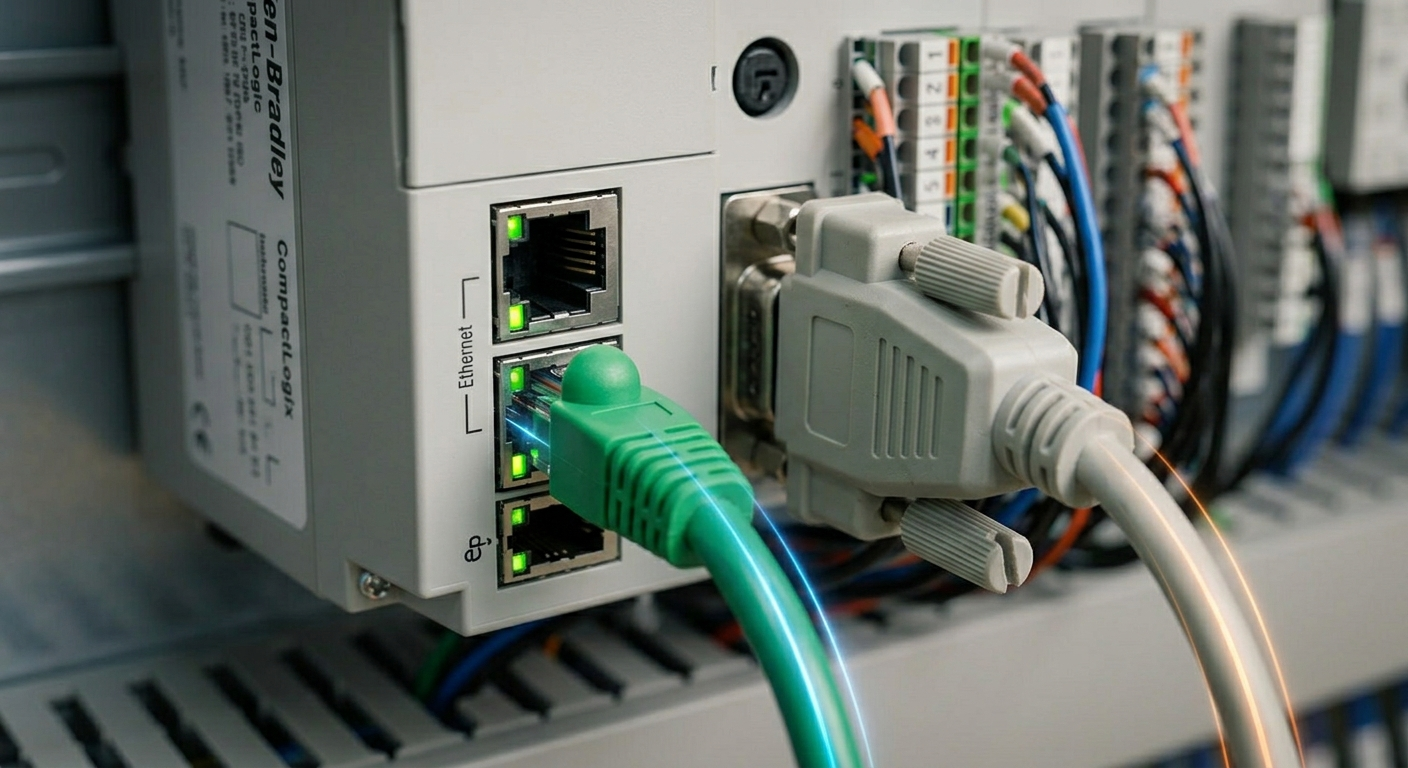
Industrial Ethernet and traditional serial communication can both connect automation devices, but they differ in topology, addressing, bandwidth, diagnostics, and how they integrate with modern plant networks. The best choice depends on the equipment, required data, environment, and support plan.
Serial communication
Serial links can be practical for legacy instruments, simple point-to-point devices, and equipment that already uses a supported serial protocol. They may require careful termination, baud settings, addressing, and troubleshooting with limited diagnostics.
Industrial Ethernet
Ethernet-based control networks support switches, structured addressing, broader device integration, and richer diagnostics. Protocols such as EtherNet/IP add industrial data models and connection behavior on top of Ethernet foundations.
Comparison factors
| Factor | Serial | Industrial Ethernet |
|---|---|---|
| Topology | Often point-to-point or bus | Switch-based or ring designs |
| Diagnostics | Depends on device and protocol | Often richer device and port data |
| Expansion | Can be limited by bus and addressing | Usually easier to integrate devices |
Migration caution
Replacing a serial link with Ethernet is not only a cable change. Review protocol, device support, data mapping, timing, network design, and commissioning. TechControl supports automation retrofits and industrial networking work.
Ready to bring your project to life?
Contact Us