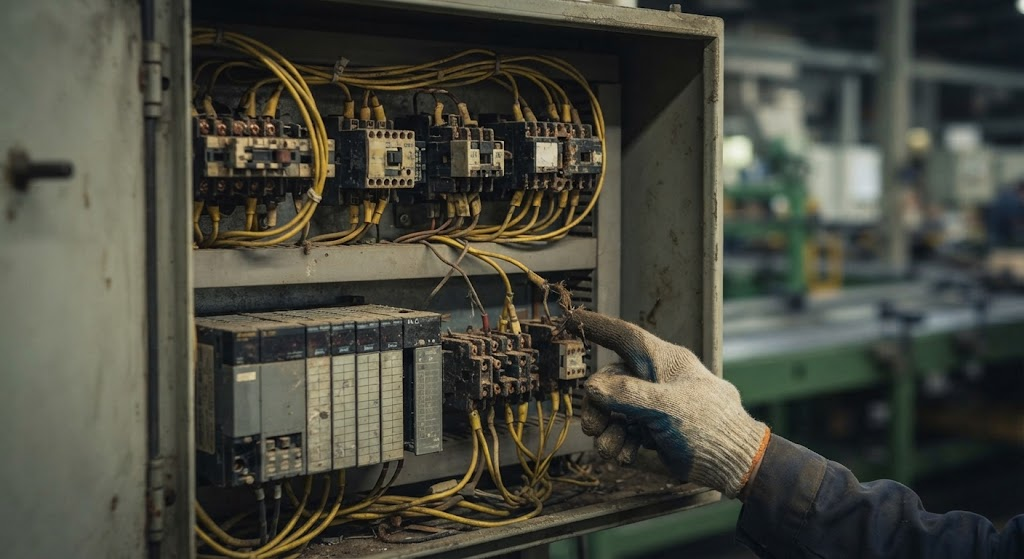
A good industrial control panel is designed around the machine, the people who maintain it, and the conditions in which it will operate. Component selection is only one part of the work; power distribution, heat, wiring, access, safety, documentation, and future service matter just as much.
Start with requirements
Define incoming power, loads, I/O, drives, network devices, environment, enclosure location, temperature, washdown, expansion, and service access. The panel should support the actual process rather than a generic component list.
Plan power and control boundaries
Separate power and control wiring appropriately, provide protection and disconnects, manage grounding, and account for drive and switching noise. Control voltage, field circuits, safety circuits, and network equipment need a deliberate relationship.
Design for maintenance
Use consistent labels, terminal schedules, wire numbers, component references, spare capacity, readable layout, and access to test points. A technician should be able to trace a signal from field device to terminal, module, logic, and HMI indication.
Verify before handoff
Panel checkout should include continuity, power-up, I/O verification, device configuration, safety checks, communications, and documentation review. Follow qualified electrical procedures for all energized testing.
TechControl provides control panel design, fabrication support, PLC programming, and machine commissioning.
Ready to bring your project to life?
Contact Us