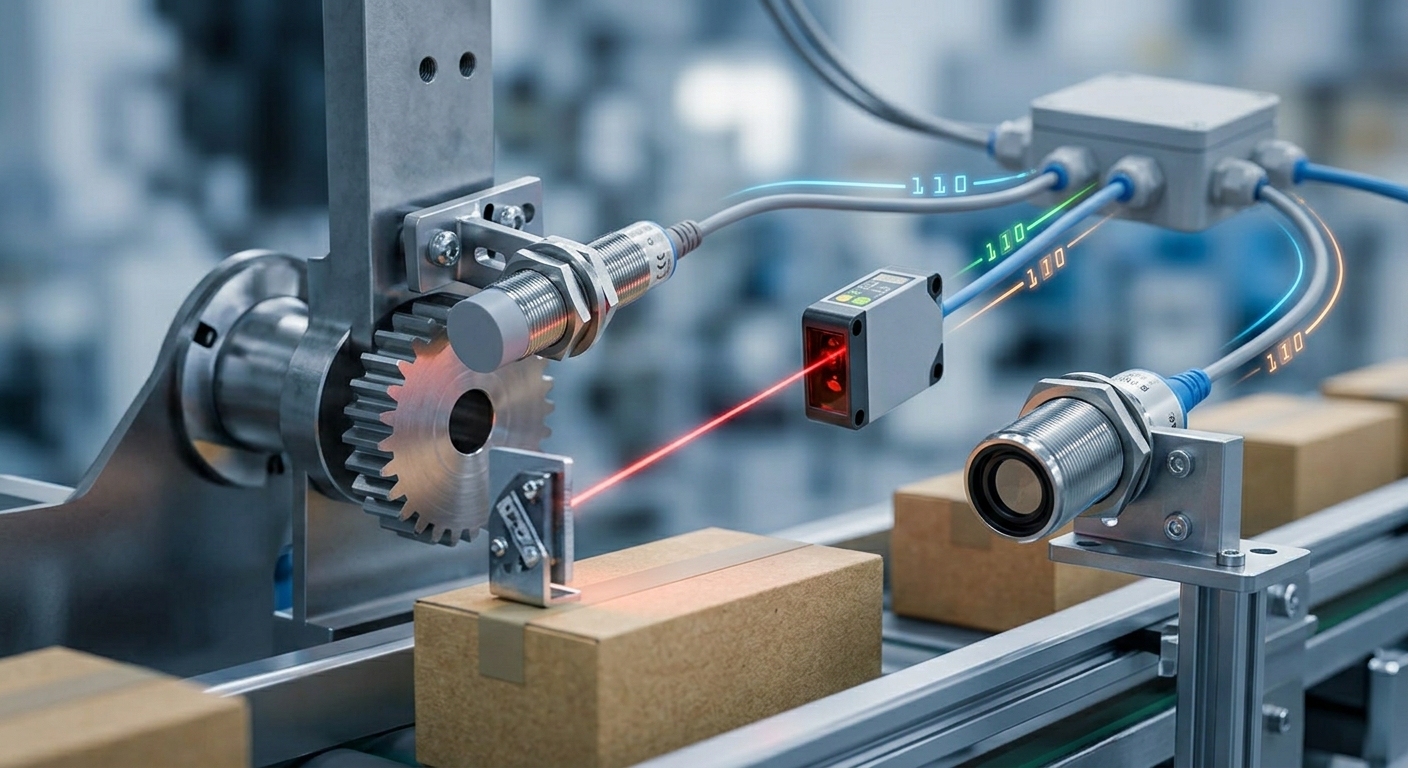
Industrial sensors convert a physical condition into an electrical signal a control system can use. They detect presence, position, distance, pressure, temperature, level, speed, or product characteristics and provide the PLC with evidence about the process.
Common sensor families
- Photoelectric sensors detect light interruption or reflection.
- Inductive proximity sensors detect metal targets without contact.
- Pressure and temperature transmitters provide analog process values.
- Encoders provide position or speed feedback.
- Limit and mechanical switches report a physical position.
What affects a sensor signal
Range, target material, alignment, ambient light, vibration, temperature, cable routing, supply voltage, and connector condition all affect reliability. A sensor can be electrically healthy and still be installed where the target does not consistently enter its sensing area.
Connecting to a PLC
Digital sensors connect to input modules using the correct voltage, common, and sourcing or sinking arrangement. Analog devices require the correct current or voltage range, loop power, polarity, shielding, and scaling. The program should expose a useful fault when expected feedback does not arrive.
Diagnosing a sensor problem
Observe the sensor indicator, measure the signal at the device and PLC terminal, compare the module LED and online tag, then inspect the logic and mechanical sequence. Do not start by forcing the tag. For field-level diagnosis, see PLC I/O troubleshooting.
TechControl supports sensor integration, PLC programming, and industrial troubleshooting.
Ready to bring your project to life?
Contact Us